and MMR immunisation
The problem
There is worldwide concern about outbreaks of measles, in the UK and the US(particularly in Texas, where have been 2 deaths). This is almost certainly linked to falls in measles (MMR) vaccination uptake, below the WHO recommended 95% rate for childhood vaccines1. I am writing this from Bristol, where there is a significant increase in measles cases currently.
Measles is a mild illness for some (that can be falsely reassuring, Mr Kennedy), but it can have dangerous consequences. It can result in very serious disease2:
- 1/20 get pneumonia
- 1/1000 encephalitis &
- 3/1000 death (respiratory/neurological)
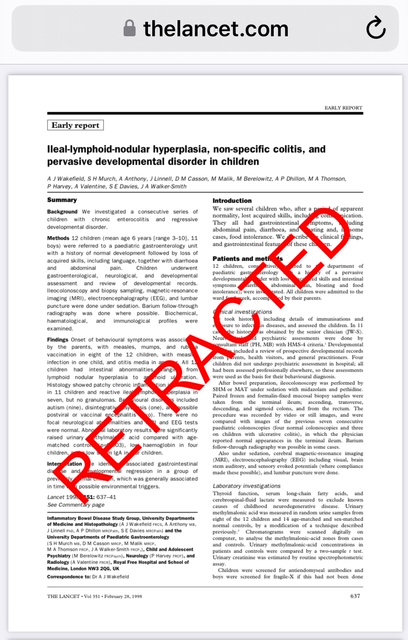
MMR is a three component vaccine for measles, mumps and rubella. It developed a bad reputation in 1998 when Andrew Wakefield published a paper in the Lancet3, which appeared to claim a link with autism, based on 12 cases. I remember reading this paper at the time with a lot of scepticism – my baloney alert went off. I was a GP advising mothers to have their 13 month old children vaccinated and I continued to recommend MMR. My scepticism was proved correct when the BMJ published a paper in 20114 using the F word – FRAUDULENT. The Lancet have subsequently retracted Wakefield’s article (Figure 1) and he was permanently suspended from medical practice in the UK. The Lancet editor and his peer reviewers must take some of the blame for causing unnecessary worry.
Figure 1: Lancet article 1998, to illustrate the retraction
| During the time between 1998 and 2011, the public became wary of MMR, as I remember clearly at work in general practice. That wariness has almost completely worn off , Figure 2. There is still room for improvement, especially in England. |
Figure 2
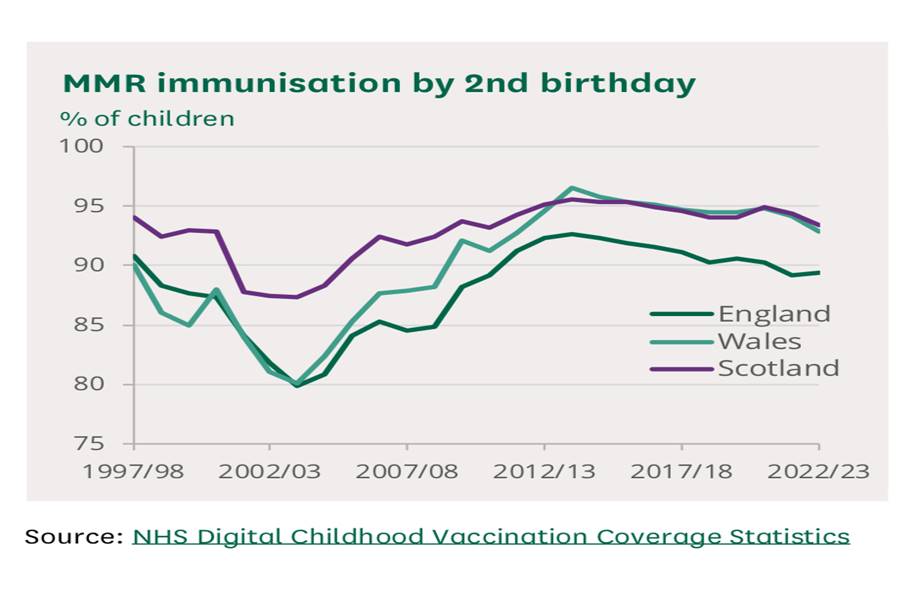
Figure 2 shows the uptake for the first MMR vaccine from 1997 right the way through to 2023. The effect of Wakefield’s atrocious research can be seen clearly 2000-2004, then a recovery occurs, some of it before the 2011 BMJ refutation. Uptake in Scotland and Wales almost reach the WHO target of 95% uptake, England’s uptake remains below 90%.
The solution
We need to tackle MMR scepticism with an education campaign to inform the public of the massive benefits of MMR, especially in epidemics. We must not forget that the vaccine protects against 2 other significant infections. The public need to be reminded of the misinformation, and its subsequent disproof. At present for example, I have seen notices in Bristol GP waiting rooms advising of the measles epidemic but none offering MMR. In my personal experience, epidemics are not seen when immunisation rates reach 95%.
Action
The Bristol Department of Public Health has some responsible for monitoring measles incidence and MMR vaccination rates and I call upon them to act. The Bristol Lab of the UKHSA also has a role to play, as do researchers, GPs, and others delivering vaccination. We need a local coordinated plan by local managers and clinicians to keep this outbreak local.
Postscript
Vegetarians and some religious groups object to the pork gelatin used in standard MMR production – they need to be aware that there is an alternative version of MMR vaccine (Priorix) not produced with pork gelatin, and freely available.
References
- Immediate and targeted catch-up vaccination needed to avert measles resurgence
- Ileal-lymphoid-nodular hyperplasia, nonhttps://www.who.int/europe/news/item/10-02-2023-immediate-and-targeted-catch-up-vaccination-needed-to-avert-measles-resurgence-specific colitis, and pervasive developmental disorder in children: A J Wakefield, S H Murch, A Anthony, J Linnell, D M Casson, M Malik, M Berelowitz, A P Dhillon, M A Thomson, P Harvey, A Valentine, S E Davies, J A Walker-Smith
- Wakefield’s article linking MMR vaccine and autism was fraudulent | The BMJ
- https://www.cdc.gov/measles/signs-symptoms/index.html
Peter McCartney
 Vaccinology